Saturday, March 5, 2016

Hanoi, Night and Day!

I generally dislike cities. I live in one of the biggest and the most populated cites in the world and that in itself makes me run away from anything similar when I travel. I live in a city which might not have a lot of sights to check, but has something more than mere sightseeing for the average tourist. It has a strong character. 
In my travels around, only Rio in Brazil had matched the colour of Mumbai. A colour which when looked at from the ground seems to be only of one shade. The shade that you currently see as experiencing the scene in front of you. That might be the grey of poverty, the red of glamour or the yellow of the bright faces one sees walking on the crowded streets. But, get above the streets and look at it from a different angle(and I don't mean going into the top floor of the towers) and you will not make up any shade. Its  a mad mixture of everything and yet there is a distinct colour to it. I love the fact that you don't know what you love in a place.
In Hanoi, Vietnam I have had a similar experience. There is something in the city I cant explain. At first when I came here 6 months ago, I immediately felt peaceful in the mad rush of its old quarter. I wasn't that far away in days from Mumbai, but even then it felt good to walk around the streets as if it was my city. The sweat was minimal though and with it the fragrance of different kinds of foods was the only thing which made my walk on the first night in Hanoi, somewhat different than the ones I have had in Mumbai. 

One of the busy streets in the old quarter, Hanoi.
 There is the Hanoi of the night which has a wild side to it, but even after my second time here I know it is not as wild as Bangkok. In the old quarter, which is the pulse of Hanoi, people, both tourists and locals sit on small plastic stools and go about their chore of eating. When I look at faces of locals and in them the tourists, all look the same. Its like they all have the colour of Hanoi on them.
Then there is the Hanoi of the morning, especially the early morning. In my first few minutes of walking on the lake front, I could smell the air different. The scent of food was still in the air but with it the sight of people, mostly locals starting with their day made me feel like a resident of the city. Tai chi on the lake remained in my mind as I had my breakfast of the Pho(noodle soup) with chicken at a road side stall and later downed a freshly brewed iced coffee. I wanted to stay for more but I had to go back to my hotel to pack up for my flight. That morning was left incomplete so I went again today. Since the last 9 days on this tour of Cambodia, Laos and North Vietnam, it is only Hanoi in the morning that made me wake up an hour before the alarm rang. 

Pho at a 'not so roadside joint'
When I think of both the times, the night has its energy like you would expect, but what makes the early morning different is along with the obvious calm there is a different pulse that comes with it. It is like the energy from the night just spilled over to the next morning. I have seen the odd food stall serving food late till the night and the same lady opening up for the morning breakfast, like she has been over the last 30 years maybe. 
Off course there are other parts of Hanoi which i haven't experienced yet and maybe they are the same like any other city with their offices and shopping malls. The old quarter however remains the place to be in Hanoi. No matter how cynic you are, no matter how much I tell myself, “oh I have had it with the dirt, cramped up food joints and loud noise”. It is to the old quarter that I return to. Like last night when I thought of eating at a shopping mall which I had taken my tourists to but eventually came back to an old quarter food joint, which turned out to be quiet an institution. Sticky rice with meat floss, white corn and chicken is what they have been selling for the last, i don't know how many years. Like the many little unknown food stalls, that have stuck to one item and mastered it. 
I am on my way back to where I live, after having ‘lived’ in Hanoi. 


Tuesday, March 1, 2016

Luang Prabang, Laos - European face, Asian smile!

My first view of Luang Prabang was on Google Images. I was not even aware that such a town existed. As my screen started to show a village like town from an aerial view with two rivers joining hands at its head, I was already clicking on more images. The initial reaction from my Hanoi based agent when I told her about wanting to add Laos and in it Luang Prabang to the Vietnam & Cambodia itinerary, was a ‘why’?
“Why do you want to go there? You have a similar kind of town in Central Vietnam, called Hue and much cheaper”, she said in one of our 30+ mails, exchanged to discuss what exactly to do different in the already touristy Vietnam and Cambodia. 
The only way I could decide between the Central Vietnam and Luang Prabang in Laos was by going to both the places, before having the tourists come with me. Back in October 2015, on a bus from Hue to Hanoi in Vietnam, I was kind of desperate in wanting Luang Prabang to be better than the architecturally old world chinese but very commercial, Hue. I had to however scrape through the madness of Vientiane, the capital of Laos to reach Luang Prabang. As I stepped out of my over crowded Toyota van, the first welcoming sign was the breath of fresh mountain air. We indians and especially people from Mumbai dislike sweat, crowd and rush when we travel. The first few minutes and I had already known that the matter of sweat is resolved, now I had to see if the crowd and rush give me a 1:2 ratio against coming to Luang Prabang. I wanted a 3:0 in favour of Luang. I still remember the relief I felt, when I first entered the centre of the town on a shared Tuk Tuk from the bus station. There were tourists, but for some reason it didn't feel crowded. 

The very French main street 
That evening when I had already made up my mind about coming to LP back with tourists, I changed a few dollars more than what I would normally on a 2 night stay. I was not worried about the left over Kip (local currency in Laos). A old world (not thankfully chinese) french town with a lot of south east asia character which dripped from the smiles of the local Lao people was a recipe for at least 3 - 4 nights of stay. 
I could just spend all the time walking on its quant streets (only post sunset) in the glimmer of the low lit shops and cafes. But I would have people with me and an answer had to be found to, ‘what to do for the period of stay’?

Trip advisor is something which I have come to have a love - hate relationship with. At the onset when one is completely unaware of what to do or where to stay in a place, trip advisor is a good platform but then I believe one should simply follow ones own path.  When a place becomes famous with a 4 star + rating on trip advisor it usually stinks of management making things work to just keep up the rating. The soul is replaced by plain smiling faces I think. When I chose the living land company for a half day excursion out of the near 2 days I had in Luang Prabang, I chose it for what their website said and how they appeared to be but the initial guidance came from trip advisor. 
When I visited the farm where the whole process from seed to feed is actively shown, I was happy. Happy that we would as a group, have a really different activity to do in the town which was at par with the feel of the town. 

'Suzuki' the water buffalow at the 'living land farm'

Sticky rice being steamed 
The other obvious choices, the Kuang Si waterfall with a asian bear rescue centre and the city tour made up for the 3 days I would choose to spend here. 


3 days ago as the flight from Siem Reap to Luang Prabang was about to land the flight attendant announced the outside temperature to be +15 deg C, a drop of 18 deg C from Siem Reap. I however knew the people would have a 180 deg turn around in terms of the feel, once they see the central street of Luang Prabang. I like it when someone from my group asks me on the first day at a place which I want them to like, “How many nights do we have here?”. In Luang Prabang as a 65 year old lady from my group looked at the Mekong from her room with a face I know well, the question came, “why are we only staying for 3 nights here”?

The river Mekong is the biggest in South East Asia and it runs through the length of Laos after beginning in China and ending in the Mekong Delta near Ho Chi Minh, Vietnam. It is in Luang Prabang that it meets the Nam Kham and therefore fish is an integral part of the cuisine here in Lao. The local snack, khai pan is a dish where, mekong river weed is dried with some sesame and fried to be eaten with a chilly paste. The paste usually is anywhere from spicy to super spicy and is therefore combined with sticky rice, a national past time. Rice is rolled in balls and dipped in any sauce, and you have a wholesome meal. The starch content in the sticky rice is more than the regular grain and therefore the average person feels and remains full till mid day after having a breakfast of sticky rice with fish or pork. The lunch again has to take care of not feeling hungry till dinner and therefore its sticky rice time for the mid day meal as well. 
We have had our quota of rice and before the noodles of Vietnam, something like a Pizza is a safe bet to give variety to the already deprived vegetarians. So it was Pizza for the guests. As for me, I had the other Lao meal. A fish fillet stuffed with pork and steamed in a banana leaf. 

Fish with Pork steamed in Banana Leaf
The more I come to Laos, the more I want to come again. As I write from my flight to Hanoi, and going back to the mad tourist rush, I know I wouldn't mind if Laos was the only thing that people remembered from this trip of Vietnam Laos and Cambodia. Without Luang Prabang and its laid back european ambience added to that the Laotian greeting of ‘Sawasdee’ coming from every person on the street, there is no Laos for me. As i sipped my last bit of the Lao mango juice on a cafe on the main street, the only thing asian about the experience was the mango, until the bill came and with it came, khop chai (thank you, in Laotian). 

Khop Chai Luang Prabang for staying Luang Prabang. 

Angkor Wat to Angkor Wat

‘Angkor Wat', the biggest temple complex on the planet. A Hindu King and his dynasty gave it all in making Angkor the biggest and the richest human settlement of the region and some say the entire world in that era. An era which when it ended in 1350 already had under it 400 years of glory. Like any other kingdom in its fag end, Angkor of the 1300’s also had a relatively meek death. The buddhist came from Thailand and conquered, and the statues of the hindu gods were replaced by idols of Buddha! The walls however lay untouched. Untouched and kept to fade away, slowly into being almost overrun by wild forests growing all around and into them. 
When I choose my travel destinations, I usually skip places with the above description. Age old history and monuments related to ‘the era’ hold no excitement for me. But something of the size of Angkor Wat in Siem Reap, Cambodia had to be done for touring purposes, just like maybe the Taj Mahal in India for a foreigner.  

In the last 48 hours, my group saw all the important temple sights. We woke up at 0430 hours on the first day and saw the sun coming up from behind the main temple. The sun shone from behind the stone and onto the few thousand tourists waiting on this side of the water pond, to take the reflection of the temple against the orange sky of dawn. Each one of us had the temple photo pass(we had to wait in a serpentine line to have our tired faces photographed), that gave us a full day access into the UNESCO sight. Some other tourists had taken their passes for 3 and a few for 7 days. I don't know how in a place over run by tourists will one be able to find peace with the monument, even if it was visiting it for a week. 

Angkor, the main temple at 0600 hours
The mad rush of tourists to take capture Angkor at Sunrise
I tried not to be over cynical with the place, so I kept my view as unbiased as possible, by not entering any of the temple. The structures however are unique to what I have experienced in the man made ancient world. But they are still man made, and thats why the only place I really felt was different, was the Wat Prong. Wat(temple) Prong(i cant remember) is different not because of its architecture, but the way nature destroyed what men made. The trees grew and they kept on growing since the 1400’s. The trees that grew in the soil were fine but then some started to grow on the roof and the roots give the structure its uniqueness. It rains and it is really rains in the wet season. The leaves from the trees after drying fell on the roof, which after decomposing, became the fertiliser. The seeds came later and took to becoming plants getting their water from the moss growing on the roof. The plant grew and when the moss was insufficient to provide the moisture, the roots reached for all the places they could suck water from, even if it meant to drop down 10 feet into the soil.

The roots reaching for the ground 
As a group and even as an individual this was my first time in Siem Reap. With the mad rush of tourists I might not want to promote it in the future. Irrespective what I think, everyone wants to strike Angkor off their ‘to visit’ list, and tourists (especially westerners) will continue to flock to Cambodia and in it Angkor Wat. With a $20 entry fee and at minimum of 4 - 5 thousand daily visitors the place has its economy intact for another 40 years.
But it is something that happened 40 years back, that caught my attention. I had  heard about the Khmer rouge in the same context as Hitler or the Bosnian war. We cant merit the ill fame of a human calamity by the number of lives lost. But if we have to arrange in descending order the ruthlessness of humans towards other human beings with the objective to achieve total control over a piece of land, Cambodia, and what happened here between 1975 and 1978 would certainly be in the top 5 human tragedies on our planet. 
I never intended to visit this part of the world and nor were / are the media channels interested in covering what happened in Cambodia in the dark years. So, I only heard of the full extent of the Khmer Rouge horror when I came to Siem Reap. 
What happens when a totalitarian regime dictates all the educated city dwellers to go and work in forced labour on rice fields? Then adding to that the village folk between the age of 15 - 20 yrs, are handed over the reign of the capital Phnom Phen, which they hold firm with a machine gun. 
Well what happens is 2 million people disappearing in 3 years from a population of 9 million. The Vietnamese then ruled the country for another 6 years, wiping out a further one million. The Berlin wall fell in 1989 and with it communism vanished from Europe. But it took another 20 for communism to leave Cambodia. 

Cambodia slowly opened for tourism in 1995. Angkor Wat became a worldwide sensation. From the greatness  of Angkor in the 1100’s to the popularity which it enjoys today Angkor Wat seems to have come a full circle. Much like the local people which are called the Khmer who are once again smiling with tourism feeding everyone. 

Angkor at 1700 hours 

Thursday, January 28, 2016

The Balkans continued - Day 4 - Kosovo in a Day!

As my eggs hit the pan, I had to shut the door to the Hostel Kitchen. The lone woman at the reception was in her 5th month and already feeling pukish I think. It was a dinner of eggs over tinned Tuna, after all Albania was over. As I sat there and ate along, I couldn't stop thinking about what I need to do the next day. Through my Macedonian coffee post dinner, I was playing with the idea of taking a road trip in Kosovo. 
Pristina, the capital was only 2.5 hours away from Skopje. But it was not the mad capital I wanted to go to. The interiors and the town of Prizren was what I had read about and had even heard from my Tirana travel agent somedays back. The east of Macedonia which had to be dealt in the summer due to possible closed roads in the winter was a strike out for a day trip. So after some “what would be the price for a day” discussion with the reception, we reached a pick up time next day. In this way Kosovo made a wild card entry in the Balkan itinerary. 

At 0700 hrs on a - 3 deg morning, the driver entered the hostel. “Do you want some coffee”? I asked the driver, as I was getting ready to leave the hostel kitchen. He promptly replied “no”. This and the opposite of ‘no’ were the two words he used mostly through our next 12 hours on the road. In the beginning all my attempts at making a conversation with him were futile as he was struggling more with the crazy fog and a visibility, than he was struggling with his english. 
Through the years of traveling in countries where English is not the first language (all but New Zealand), I learnt very quickly that rather than them it is me who needs to speak their language in order to have a basic communication. Still, I have to be honest and say that it does get irritating at times when you are not alone and have a group of people waiting for a proper reply. On that foggy winter morning, however it didn't matter, as I was without my tourists, so it was all good. 

Kosovo has a very dark past. First, it was in the joint Yugoslavia and even then 90 % of the population was Albanian. When Slovenia, Croatia and even Bosnia gained their independence from ex Yugoslavia, but more to say, from Serbia, Kosovo kept being watched over closely by its strong neighbour, Serbia. After Serbia let Montenegro go on brotherly grounds(both are orthodox catholics), it was Kosovo’s turn to declare itself free. The result, bombing and mass genocide of villages in Kosovo by the Serbian army. The Serbians I have met in my travels don't fully agree, but it is only after NATO bombed Belgrade, did Serbia withdraw its army from Kosovo. With that came also the mass exodus of the 15% orthodox catholic population to either orthodox Macedonia, Serbia or Montenegro. 
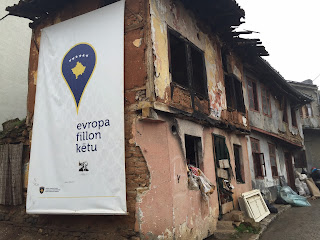
The Bombed building from the war and the poster asking European Union to take notice
Its not some 100 yr old text book thing, it happened less than 10 years ago and so the wounds are fresh. They can be felt in a different way in Kosovo than in Bosnia, where it was worst coz a neighbour killed a neighbour. I was expecting real poverty as I stamped my passport and entered Kosovo. What I saw was a major industrial zone instead. Automobiles and everything related to it. I guess it were the taxes or something in this youngest country in Europe that had turned it into an industrial hot spot of the south east. As we drove through the countryside and to Prizren, I noticed more and more cars with Swiss number plates. In towns there were Pizza places called, ‘Norway Pizza’. Refugees of Syria are in news now, in the late 90’s however there were the other kind of refugees, The Balkan refugees. I looked out of the window and thought, ‘what has changed since’?
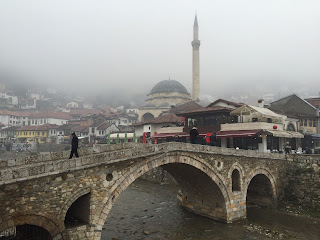
Prizren, Kosovo, on a cold winter day ..
The winter fog spread over Prizren, and through it pierced the minaret of the central mosque, screaming the muslim roots of the town. It was below freezing when I got out of the car and in the first 10 mins decided that Prizren would be a stop over for lunch in the itinerary and not maybe a place to spend a night.  It had a old town with cobbled stone streets and cafes lined up to serve the summer visitors, but the charm was missing.  The air was getting colder and I was ready to leave and proceed to my next stop, an orthodox monastery in the middle of a muslim land. 

UNPROFOR is a short form of United Nations Protection Force and never in Kosovo is its presence more felt than in town of Decan, which is ethnically muslim. It was also here that I saw statues of soldiers who had laid their lives fighting for Kosovo’s liberation and the Albanian flag was always there to give company. 
Some 2 kms from the town is the monastery where twenty orthodox catholic monks go quietly about their business of growing grapes and making a top quality red wine. The abundant green in the compound makes for some of the best goats milk cheese you can taste. 
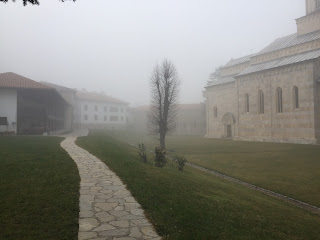
The Decani Orthodox Monastery
The monastery was particularly special for my orthodox catholic driver who for the first time said more than yes and no. “This place, i want to come”, he said as he parked his car. The road to the monastery was heavily guarded as the last attack by the locals happened just 5 years ago with a few hand grenades being whirled inside the compound. I was told to give my ID at the check point by an Austrian young officer who was busy biting into his ham sandwich. With a ‘Visitors’ tag handed over to us, both me and the driver entered into a different world, right in the middle of muslim Kosovo. A young man showed us around and even spoke to the driver about the place. The driver had the face of ‘oh ya, I discovered something new’. I had to buy a bottle of red and a nice yellow goat cheese before getting back in the car. The place felt, I don’t know how to say, just special!!
Just 15 kms from the monastery was Pec (pronounced as pech) in Serbian and PeYa in Albanian. and as it is with all the town sign’s on the road, the cyrillic serbian letters were blackened by the locals, which announced that we were entering Peya. 

The temperature had dropped to - 5 and it was really chilly when I decided to take a random walk in the old town. The town reminded me of Sarajevo in Bosnia, after all it was the Ottomans who ruled this land for 400 years. The highlight of the walk was a stop at a local kebab place. I avoided a few Kebab places on my walk, but when the chill got to my bones, i simply walked in the next food joint and what a joint it turned out to be. The menu was priced in cents and the food was certainly worth more than the 2 euro 50 cent bill I payed. The warmth with which the four guys at the grill served the meat, made this place all the more a ‘no fuss eatery’. 
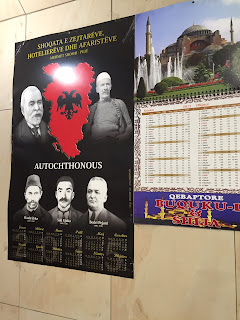
Both Albania and The Blue Mosque in Istanbul visible in everyday life in Kosovo
The batteries of my watch had given up on me but it was more than just that which I got from the local watch shop. “Why dont you stay here, you should know this place before you get your people here”, said the son of the watch maker. I know if I said yes, he would take me to his house. :-)

Those were the last words I heard from a local before I quickly skipped through the capital Pristina on my way back to Skopje. 
Kosovo is special .. not too pretty just special. “I drive to Tirana in 5 hours and pick up from Shereton” the driver said as he dropped me to my hostel. He had got his english tongue magically from somewhere, but I guess it was for his next pick up. 

As for me I had got the taste of Kosovo in a day. 

The Balkan's continued - Day 3 - Crossing from Albania to Macedonia on foot (nearly)

After an evening with food, I wanted to eat something light for the morning, as I was 30 mins away from taking the bus. “It’s just 5 mins by taxi, the bus station” said the mother, as she got the big veggie omelette to my table. Later I would thank her around noon, silently, for not letting me leave on a bread and honey breakfast. I was heading to a town in the east of Albania from where I was told ‘a transport’ would be available to the border. I was waiting for a similar shout of ‘last stop’ from the conductor but he looked at me and said “Macedonia, Here”. The bus dropped me in the middle of an intersection well before the last stop. I think he just told someone on the road that I need to cross the border. I had to pee and as I asked for permission to enter a ‘closed for business’ cafe, the woman said “yes” and when I came out “Macedonia, wait”. The Albanian kindness continued. 

On the intersection again, a bystander approached me and said “Macedonia, come”. Not knowing where he was taking me my feet followed him hesitantly. I only picked up some pace when the same man to whom the conductor had spoken earlier and had gone missing since, appeared from nowhere and he too went “Macedonia, go”. Like two was better than one, I followed the man with the ‘come’ as he was seconded by ‘go’. The man turned out to be a driver who helped me with he luggage into the back of his van pulling out 2000 Likas from his wallet. 
It was a fare amount i thought for a lone passenger to be had for 40 kms. But like the bus from Tirana, this was a ‘mini bus’ to the border town and not some taxi that I could stop in between to take some picture. The road did get scenic as we left this dusty town and we enjoyed the company of an unused railway line and the river flowing completing the trio of modes of transport.  The van was soon filled with random people who were going to different places on the Albanian side of the border. 
As the vehicle scaled a new mountain road, the driver simply uttered the word ‘Macedonia’ with a finger pointing out to the border control. A nice wind made the flag of Macedonia flutter with grace,  on the other side of the Red with eagles Albanian Flag. It seemed that both the flags were in Sync, forgetting how their countries have always had a unsteady relationship. 

Sometime later I was told that if you wanted to cross the border from Russia into Norway, it was ok to enter Norway on foot but it was not allowed to cross Russia without your limbs stepping on at least a paddle if not an accelerator. Russian Cycles were being sold to or rented to refugees to cross over from Russia and they would just lie there in the no mans land as they preferred to walk to Norway. If I knew this at my border crossing from Albania to Macedonia, I would've certainly answered the call of the elderly taxi man while still in Albania. I missed the opportunity of crossing my first border on two feet, as I simply took the taxi into Macedonia. “A good deal to Ohrid” he had said. The long line of four wheels at the control and then seeing passerby’s actually crossing over by foot, made me kind of hate the ‘lets play it safe’ guy in me. 

It was another 40 kms drive to the town of Ohrid in Macedonia.  I never mentioned the Macedonian Border police being thrilled and a little doubtful at the fact of an Indian going into Macedonia from Albania. “So you will show Macedonia to Indians” were the first words that came with a smile from him, after the initial, “you go, Macedonia?!! Why?!” with raised eyebrows. 
I have to confess that I over expected from Ohrid. My friends in the neighbouring countries had spoken highly about it. The town to my shock was even touristy in winter. The lake was covered in the winter haze and the food over priced. I think it was the combination of the over expectation and the central street being crowded on a regular winter day that made me think, “what would this be in the season”. I had checked in but not pre paid at the hotel booking website, through which I had booked the hotel. Like in Berat I had gone for a walk after throwing my bag in the room and like Berat I had expected it would stretch to at least 2 - 3 hours. But, I was back in the hotel after a short 90 mins, in which the stale fish served to me over a wonderful bread and local butter ruled for 30 mins.

The only bright spot in Ohrid - Not even the Fish but the Bread. 
“I would like to pay”, came my words to the lady at the reception. “Well you could do it tomorrow when you leave” was reply. When I told her that I was leaving ‘now’, she couldn't hide the disappointment. “Did you have any problem with our hotel”, said the lady  and then I said something which I don't like if I come to think of it today. “No, its just Ohrid”

Without Ohrid, I was lost not knowing what can Macedonia hold for the 3 nights I had in my mind for the country, which was to be a major attraction in the Balkan itinerary. On the bus back to the nation’s capital Skopje, I was thinking, should I just take a bus to Kosovo on arrival. 
I ended up staying for two nights in Skopje, and thankfully I chose a hostel, where the woman made it her goal to make me fall in love with the country everyone talks about, Macedonia. 

Thanks to her and her talks about the east of Macedonia, I actually started to think of a possibility of not doing Slovenia and Croatia in the tour and entering and exiting through Greece to make it a more rustic tour. Keeping it more towards the east rather than a east to west tour. 

I know I would have to travel back to Macedonia to find what I did not in my first visit. I hope I find my Macedonia then. 

Saturday, January 23, 2016

The Balkan's Continued - Albania - Ottoman Berat, Day 2.


I had read about the Hotel Mangalemi, before I passed it as i stood in the ‘Linar 1’ bus to the centre of Berat. More about Mangalemi later. The taxi from my hotel in Tirana, took me to a bus station where the only sign that it was a bus station was a information board showing the timings of busses. Without a single human being in a radius of 100 metres, and certainly no busses, the driver had to shout out to a couple of guys sitting in a cafe outside, which sounded like “hey fellows”, the guys never looked and were busy in their board game as vapour came out of their mouths with the morning crisp sunlight hitting their faces. “Hey, guys, where the F### is the bus to Berat going from”. I think the guys only replied coz they heard the F word. However in the next 10 mins, I found out that the directions were based on the F word and they were wrong. This time the driver was more like “excuse me” as he asked an elderly man on the road who was busy with a group discussion, and in return everyone around him replied but the man just smoked and smiled. At least they all pointed in the same direction! 
In a few minutes I was on a bus that had been tagged Berat. It was a cold winter morning and although I wanted to wait out, I chose to keep myself warm on my seat in the old coach. Outside, the guy who was the conductor, kept on with his Berat shouts, as each public bus came in with people wanting to go somewhere. This was my first bus journey in Albania and I didn't know how things worked here. Whether the bus leaves on the time it is supposed to, or it leaves when it feels full to the driver? With only 50 % of the seats taken and a mere 10 min delay (according to the scandinavian standards) we left the ‘hard to find’ bus station in Tirana. 
Within 15 minutes the apartment blocks started being replaced by country houses and most of them had the Albanian flag on them. The blood red and on it two eagles facing to their sides would be a common sight, I would come to know, even in Kosovo. With only 80 kms to cover I soon understood why the bus was to take 2.5 hours to touch Berat. People, they kept on getting in, and for some reason like my travels in Bosnia and Serbia, baring the seat next to me, all the seats in the coach were taken. I have to say, that no matter how much I like my space, I did not understand why no one wants to sit next to me :-). ‘India’ was always an ‘Indiaaaaa’ when I replied to the locals when they asked me “so where from are you”. 
Unlike Serbia however the driver and conductor kept to the ‘no smoking’ norms in the vehicle and that was a relief.

The Ottoman Houses I was looking for ..
“You might even get back to Tirana in the night”, had said my travel agent in the morning. In the beginning I didn't consider that to be a possibility but when the conductor shouted ‘Berat, last stop’ I had been expecting something more than what I saw around me. Ottoman houses, white washed and idyllically placed on the hillside with a river running alongside was the image I was looking for. All I saw around me were apartment complexes in the of the dust that rising from the road. 

With both my hands on the stroller and my eyes still searching for Berat, Linar 1 pulled up in front of me. The people got in, and I did the same. In just about 5 minutes the river came in view and in another 2 came the houses on the hill. The apartment complexes were left behind and what was ahead of me was worth the Unesco World Heritage status. 
With not knowing where to get down, I just worked my way through the crowd as soon as I saw the ‘Mangalemi hotel’ on a cobblestone street leading up. I had read about it the earlier night in the lonely planet and I loved the first impression of this old Ottomon house, which only got better with the evening. The owner was kind enough to give me a Eu 15 price for the night for a very comfortable space dressed in wood. It was specially nice to see a decent space after spending the earlier night in what they call a ‘by the hour’ hotel in Tirana. 


The Stone Bridge 
I had only a couple of hours before night fall and so my shoes never came off in the room. It took me close to 3.5 hours of walking around the town which mostly involved hiking up the palace hill. At the end of it, I was happy to come back to the hotel and to reach a conclusion about Albania. 
What was supposed to be a lite bite at 5 pm, turned out to be a series of bites for the next 5 hours. The owner was a 28 yr old guy and was translating a very interesting conversation between me and his mother who was the hand behind my being glued to the wooden seat from 5 to 10 pm. The food .. what can I say!! She had a limited menu of 7 - 8 things and I tried them all. “She say’s she is very happy to see you eat, but seriously I never thought you could eat so much” said the son. “Even me” I said, with the walnut dessert still on my tongue. Maybe ‘no beer’ helped, or maybe it was just the idea of ‘Albania in a platter’ which the woman said I should go along with. The cosmetic beauty of Berat was wonderfully presented in the warmth of its people. A combination that always works to make a place welcoming. 


This is the way to serve a cold Rakija 
Berat was what I had wanted Albania to be and that night I slept in peace knowing I would come back to Berat again. 

The Balkan's Continued - Albania - Tirana, Day 1.

I always wanted to go to Sarajevo in Bosnia, don’t know since when, but I had the calling. So when the opportunity finally presented itself in the end of summer, which is the end of my touring season as well, I got on a bus from Zagreb and onto the other part of the Balkans, Bosnia and Herzegovina. 
Croatia and Slovenia were still the Balkans, but I would like to call them the European Balkans. It is only when you step on the soil in BiH (short for Bosnia Herzeg) do you really step in the Balkans, I believe. The reason for this intro being that in that travel time of summer, I never thought I would end up in the far east of the Balkans, in the middle of winter, that too in the same year. 

I dropped my first Scandinavia winter group and took a flight to Tirana. Albania, the name had no reaction from me a couple of years back. Then this year, it just became a part of the whole Balkan circuit, which contained Macedonia, Kosovo and Serbia as well, after doing Montenegro and Bosnia. This is a part of the ongoing research I am doing on planning an Ex Yugoslavia itinerary. It however became clear in the first 24 hours in Albania that it is a rightful choice over Serbia and therefore the name, Ex Yugoslavia had to be changed, to just ‘The Balkans’. The name is not important in planning an itinerary, the choice of places is all that matters. 

Today as I write, I realise that the planning of a tour of the Balkans, might be even more difficult than South America. The scale is not as huge as South America, but the distances are a lot if you consider traveling from Slovenia in the west to Macedonia in the east. This is what is challenging and makes the whole process of getting people here a responsible one. Responsible towards the Balkans and to promote the region in the Indian mind set where the most famous places can and will take a back seat and countries like Albania or Kosovo will come to the forefront. 

It feels good to plan an itinerary, knowing that nothing like this has been done before, not only from India but also by European or American tour companies, which mostly are stuck with familiar places like Dubrovnik in Croatia and Mostar in Bosnia. 

Very often in movies and in general, the image of Albania is very mafia like. Crime on the streets, poverty, is what I had heard loosely off. Since Albania was never on my to visit list, i did not even bother talking about it to my Balkan friends, which were mostly tour guides and drivers who themselves had never been this far east. Once, when I saw a tourist van with Japanese guests being checked at the SLO - CRO border, I asked my driver casually, “why are they being checked. they look like Japanese”, “Albania”, he said. “Albanian number plate”. 
Oh ya, I thought, the land of Mafias. 

The Central Sq. showing the communist painting
 In my first few hours in Tirana on a  + 2 deg night, wandering in the hip cafe district, I felt like laughing at my own oblivion about the country I was in. It felt like Zagreb on a weeknight (the weekends felt like Ibiza, in Zagreb). I kind of walked the whole of the Tirana centre in 2 hours and I noticed for the first time, an orthodox cathedral and a mosque being done up in the same christmas fervour. Its important to note here that none celebrate christmas. The orthodox celebrate it on the 7th Jan and the muslims, well!. In one view, the entire impression of Albania changed. Of course it also helped to hear “we in Albania, have only one problem, Economy, religion is open”.


The Church and the Mosque in the same light.

I was quiet pleased at the open ness of people. No women had a head scarf, even in the countryside. This was Albania, the land like any other in Europe and yet it felt different. 
I felt like traveling more in this country, but I was here on a job, the job to give 2 or 3 days maximum out of the 12, I had thought of giving the Balkans to Albania, having made the decision of actually including it in the tour. Albania didn't make my job any easier, as I had made up my mind in the next 24 hours that I need to give Albania more time. Berat, a town 120 kms to the south of Tirana, was greatly responsible for making me want to see more in Albania. To show the fellow Indians, what felt like being in the Balkans.